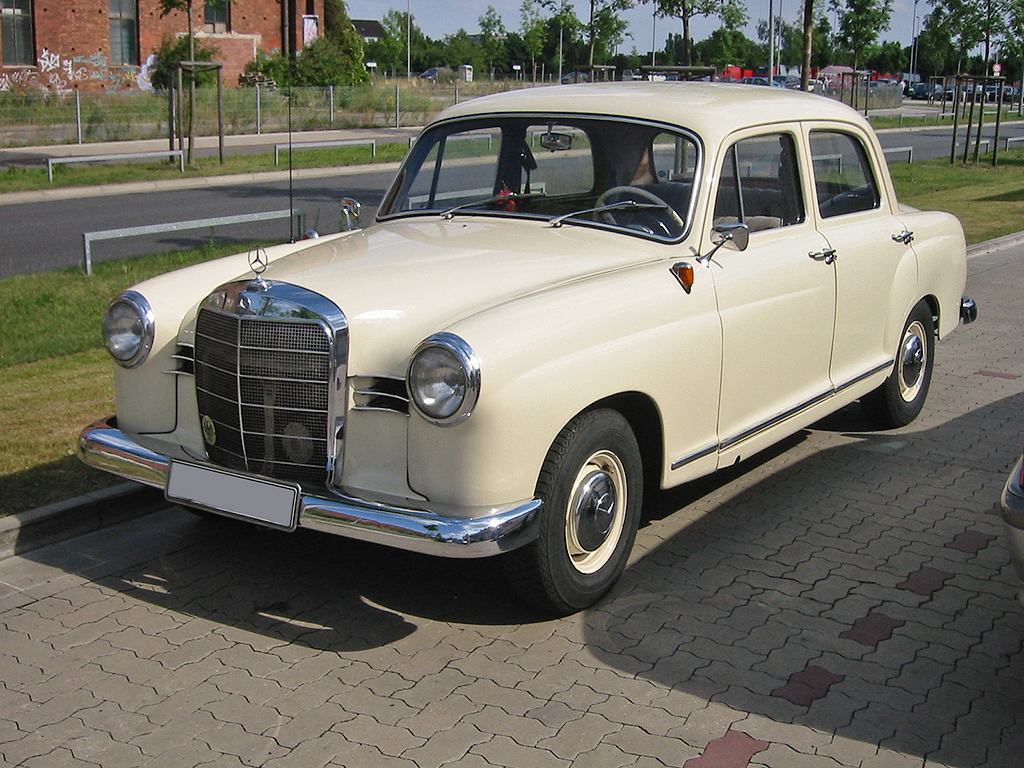
 We are now at the 17th book written by Herge, “The Calculus Affair”. Till now there had been certain unusual activities happening at Marlinspike Hall. Especially, glasses were breaking for no rhyme or reason. There had been firing on the estate and Police had already visited on a number of occasions in a Land Rover Series 1 and a Citroen 2 CV. In my last post, Professor Calculus was on a walk and was overtaken by a Volkswagen T1 panel van (the red van seen in the picture above). At this moment the villains had been waiting in a black car to kidnap our Professor. The car was a W120, Mercedes 180.
 The Mercedes 180 was manufactured between 1953 and 1962. It was assembled in Germany, Australia, UK and South Africa and it is believed that 442,963 cars were built. These cars were offered with both petrol and diesel engines. A large number of cars with diesel engines were used as taxi in Germany. These were the first cars to be introduced by Mercedes with a spring loaded Mercedes star atop the faux external radiator cap. This star would give way in case of a bump and then return again to its position. This may have been done in favour of pedestrian safety, an effort to reduce injury to pedestrians in case of an accident. This feature was thereafter introduced in all Mercedes models.
 This car was mid-size (Executive) luxury car and may be considered the philosophical ancestor of the present day E-Class. They were offered as a four door saloon, however, Five door combis (station wagons) have also been seen. These cars formed part of the “Ponton” series of cars. Ponton means pontoon in German. This was a family of cars built on a monocoque chassis. They had crumple zones and non-deformable passengers cells. The crumple zone is a patent held with Mercedes and forms a decisive part of passive safety in cars. A Feature that is essential and common in all modern cars.
 The Mercedes 180 was powered by a 4 cylinder inline naturally aspirated petrol engine which displaced 1,763 cc (107.7 Cu-inch). These engines breathed through two valves per cylinder and produced 58 BHP at 4,000 rpm and 115 N-m (85 lb-ft) of torque at 1,800 rpm which was used to turn the rear wheels through a 4-speed gear box. These engines could push these 1,600 kg (3527 lb) cars to a maximum speed of 126 km/h (78 mph). The Mercedes 180 accelerated from 0 to 100 km/h in 28.6 seconds.
 On the other hand, the diesel models were powered by a 4 cylinder inline naturally aspirated engine breathing through 2 valves per cylinder and displacing 1,763 cc (107.7 Cu-inch). They produced 43 BHP at 3,200 rpm and 104 N-m (77 lb-ft) of torque at 2,000 rpm. This was again transferred to the rear wheels through a 4-speed gearbox. These cars weighed 1,650 Kgs (3,638 lb) and could be pushed to a top speed of 110 km/h (68 mph) and a 0 to 100 time of 45.2 seconds.
Stopping power was provided by 230 mm drum brakes on all four wheels.
 The suspension comprised a double wishbone on the front wheels which was bolted to a front axle carrier instead of directly to the frame. This was a unique and innovative feature at the time. The U-shaped axle carrier also accommodated the engine, transmission and steering. It was mounted to the front section of the frame with silent blocks for low noise levels. The rear wheels were suspended on the tried and proven swing axle. However, they were additionally controlled by widely spaced trailing arms.
 These cars were the mainstay of Mercedes’ lineup during their production runs and along with 190 and 220 models they constituted 80% of the Mercedes production between 1953 and 1959.


Leave a Reply